“Associate as little as possible with the ex, preferably by e-mail and keep it all business. The children will recognize what you are doing by the time they are pre-teens. You need not say a thing.Other mothers who are co-parenting with sociopaths have found that their children are very perceptive. Kids can see through the sociopath’s façade to his “meanness.” Sometimes they see the evil before adults do.
Compliment your child daily, even over the phone when they are visiting with their father. Ask questions about their day and how they feel and what their opinions are on different subjects and issues. Let them be HEARD; the narcissist will never really hear their sweet voices. Hug them and display closeness by holding hands, smiling, laughing and joking with them.
Criticize when necessary, but only in private. Make sure they know it is the action you do not care for, but you still love them, no matter what, period, and SAY this to them. Praise them in public and not just for their accomplishments, but just for them being who and what they are. Soften your tone and voice, they need to hear kind words and thoughtful manners to wash away the strident harshness of their father’s cruel, acerbic and almost always critical voice.
Let them know, in the most non-offensive way, that you do not approve of their father’s actions, as they are disrespectful to others. Make sure they SEE YOU behaving in a loving, accepting and respectful way to all others. Let them see you being kind frequently, no matter how small the kindness. Show them how to do the right thing under all circumstances and to be kind, no matter what. Teach them that all they can truly control is themselves and live this one (especially) by example!
Tell them each day that you love them, and I mean every day. Admire their accomplishments, encourage them to be frank, open, honest and to speak their minds, even to their father. Assure them that you are 100% behind them at all times. Teach them not to be afraid of this man or anyone else, and that they are worthy of the love they receive from you and others.
Lastly, when the time is right, let them watch you and include them often in a loving relationship with a normal man. They will discern what is right and what is narcissistic behavior.”
Tuesday, July 23, 2013
How one mother copes

K.I.S.S. And Tell: Fight a Sociopath and Win!
Sad but true and effective when dealing with family court!
FROM:
http://coparentingwithsociopath.blogspot.com/2012/11/kiss-and-tell-fight-sociopath-and-win.html

I have to laugh every time I check my analytic's page. Especially the keyword phrases that people use when searching for information on co parenting with a sociopath. Don't misunderstand- I'm not laughing AT them. I am laughing at the absurdity of the fact that ANY of us are having to learn how to co-parent with a bonafide sociopath. Unbelievable.
Here is what I HAVE figured out about winning a battle against a sociopath: It is possible and it isn't that hard. I have developed a theory I call K.I.S.S and Tell. So, far it has been working for me. Here is how it works:
K.I.S.S. stands for Keep it Simple, Stupid. Sociopathy is hard to explain to someone who has never lived with it. The traits are not. Predicting the impact on a child isn't hard either.
If you run into court saying your ex is a sociopath and he tries to make you look crazy, then the judge WILL think you are crazy. The ex will snicker and laugh and say, “see, I told you she was nuts!” Emotionally detach yourself from your case. If you focus instead on proving a pattern of behaviors and painting a picture for how this will impact your child, you will come across as grounded. Judges like grounded.
I highly recommend the book “Teaching Right from Wrong – 40 Things You Can Do To Raise A Moral Child” by Arthur Dobrin. It is all about how to raise an ethical child- which a sociopath knows NOTHING about. It is also a valuable blueprint for telling a judge what your child needs and how you can do it better than a sociopath.
FROM:
http://coparentingwithsociopath.blogspot.com/2012/11/kiss-and-tell-fight-sociopath-and-win.html
K.I.S.S. And Tell: Fight a Sociopath and Win!
I have to laugh every time I check my analytic's page. Especially the keyword phrases that people use when searching for information on co parenting with a sociopath. Don't misunderstand- I'm not laughing AT them. I am laughing at the absurdity of the fact that ANY of us are having to learn how to co-parent with a bonafide sociopath. Unbelievable.
That
being said, I have personally been put through the ringer trying to
figure out how to convince a judge that my ex is a sociopath. You
would think that a psychiatrist testifying to the fact would be
enough. NOT.
I have
worn the search engines out looking for information about how to beat
one in court, how to win against them, how to protect my child from
one, how to testify against one, how to explain ASPD to your
attorney, and how to co-parent with one. The answers are hard to
find.
Here is what I HAVE figured out about winning a battle against a sociopath: It is possible and it isn't that hard. I have developed a theory I call K.I.S.S and Tell. So, far it has been working for me. Here is how it works:
K.I.S.S. stands for Keep it Simple, Stupid. Sociopathy is hard to explain to someone who has never lived with it. The traits are not. Predicting the impact on a child isn't hard either.
Q:
How do we tell a judge a sociopath is bad for a child? (Again,
laughing... it is sooo wrong we should have to do this, duh!)
A:
Tell him about morality as a predictor for future criminality and
values as an ability to instruct and inspire the child in
preparation for becoming an asset to the community BUT don't throw a
label onto your ex.
After
all, aside from the abuse and neglect that our children must suffer
now, our biggest concern is the impact a sociopath will have on their
future. (I am not minimizing abuse and neglect, but I am avoiding it.
Bringing this up in family court is an almost guaranteed way for a
mother to lose custody- even if the sociopath admits to it and even
if you can prove it beyond a shadow of a doubt.)
If you run into court saying your ex is a sociopath and he tries to make you look crazy, then the judge WILL think you are crazy. The ex will snicker and laugh and say, “see, I told you she was nuts!” Emotionally detach yourself from your case. If you focus instead on proving a pattern of behaviors and painting a picture for how this will impact your child, you will come across as grounded. Judges like grounded.
I highly recommend the book “Teaching Right from Wrong – 40 Things You Can Do To Raise A Moral Child” by Arthur Dobrin. It is all about how to raise an ethical child- which a sociopath knows NOTHING about. It is also a valuable blueprint for telling a judge what your child needs and how you can do it better than a sociopath.
So,
try to keep your case simple. Complicated equals confusion.
Sociopaths thrive on confusion.
… and
tell. What is a sociopath's ONLY FEAR? The truth being revealed. Do
tell about what has happened in your life and the hell that your
child is going through. BUT be clear that you can separate the past
from the future. The reality is that in the current court
environment, you WILL be forced to co parent with the sociopath. If
you suggest anything less you run the risk of losing your child to
the sociopath completely.
I used
to keep my mouth shut about the abuse. I was embarrassed. Now, I tell
every chance I get. Once people hear it they start noticing things on
their own. The sociopath hates it, which triggers his issues and
causes him to make a fool out of himself. I made the mental shift
from victim to survivor and people are starting to see through his
act. Me telling has caused him to sabotage himself.
He is not winning anymore.
I
believe in K.I.S.S. And Tell because I tried it the other way and I
LOST. Then I learned that I was not alone. Thousands of mothers and
children go through this very thing. The more outraged against the
injustice we become- the harder we fight to reveal the truth – the
tighter the noose around our neck gets. In this way, we mothers have
a LOT to learn from corrupt father's rights groups and perhaps from
sociopaths as well.
Wednesday, June 26, 2013
Narcissistic Victim Syndrome: What the heck is that?
Narcissistic Victim Syndrome: What the heck is that?
Sunday, March 11th, 2012 at 4:25 pm
 When a man or woman suffers from a condition named Narcissistic Personality Disorder, they display patterns of deviant or abnormal behaviour that is so bad, that it creates carnage on those people who are unfortunate enough to have a close relationship with them.
The dysfunctional behaviour involves such callous exploitation of their victims that it has given birth to a new condition known as Narcissistic Victim Syndrome (or Narcissistic Abuse Syndrome). While plenty has been written medically about Narcissistic Personality Disorder (NPD), little or nothing has been written about Narcissistic Victim Syndrome (NVD). The Diagnostic and Statistical Manual of Mental Disorders (DSM-IV), which is published by the American Psychiatric Association, and it is considered the “bible” for all professionals, covers NPD extensively. However DSM-IV has not written anything about the effects on those who live or work with the narcissist’s torturous behaviours, and the consequences of that behaviour on the mental health of the victim. Thanks to the dedicated work of many psychotherapists, it has become clear that a set of detectable characteristics occur when working with victims of narcissistic abuse. The good news is that American therapists are calling for the recognition of this syndrome to be included in the next Diagnostic and Statistical Manual (DSM-V, to be published in 2013), in the hope that all therapists will be given standard guidelines for formulating a way of working with this syndrome.
First, What do we mean by “Syndrome”?
The word “syndrome” comes from the Greek “syn”, which means together, and “dramein”, which means to run. So a syndrome is a set of signs and symptoms that tend to run together in a cluster that can be recognized as causing a physical, mental, emotional, and spiritual abuse. In order to be able to diagnose a client suffering with Narcissistic Victim Syndrome, the therapists needs to be able to gather together the signs and symptoms and access the client’s psychological make-up as their story unfolds. That way they will be in a position to know if the person is suffering from Narcissistic Victim Syndrome, or a lesser form of abuse on their mental well-being.
Do therapists know enough about the effects of Narcissism on the Victim?
Speaking for psychotherapists in Ireland, I can confidently say “definitely not”. Narcissistic Personality Disorder is predominately the domain of psychiatrists, psychologists, and the mental health services; so naturally, rarely would a diagnosed narcissist be consciously referred to a psychotherapist outside of the Mental Health Services. Naturally, as a consequence, the mental health services only concentrated on the vulnerability and treatment of the narcissistic patient in their care, their priority is not the victim; unless the victim ends up in psychiatric care themselves somewhere down the line at a later date.
Victims are more likely to present themselves in counselling or psychotherapy, not because they know that they may be suffering from NVS, but because they are not coping with their lives. I have spoken to many other psychotherapists, and although they know of narcissism, none feel that they have been sufficiently trained for recognizing narcissistic behaviour and its effects on victims, let alone work with Narcissistic Victim Syndrome. Because most Irish psychotherapy courses do little or no training in this area, and the fact that little or nothing has been written in the medical literature regarding the victims of narcissistic abuse, it is my observation that, the majority of therapists, through no fault of their own, are ill equip to work with clients with this syndrome. If you read any of the Support Forums for survivors of narcissistic abuse, you will constantly hear them say that their therapists did not understand the depth of suffering they had been subjected to, and that the term “narcissistic abuse” had rarely been mentioned to them.
Understanding Narcissistic Victim Syndrome (NVS) first requires an understanding of Narcissistic Personality Disorder (NPD):
In order to be an effective therapist in the area of narcissistic victim abuse, it is vital to understand all that you can about the spectrum of narcissistic behaviour. The spectrum of narcissism exists on a continuum, from healthy narcissism, to unhealthy traits, and all the way to pathological Narcissistic Personality Disorder. By the way, the narcissist does not have to display all of the traits associated with the full blown pathological stage of narcissism in order to do untold damage to their victims. For that reason, therapists need to familiarize themselves about narcissistic traits and the relationship dynamics between the narcissist and their victim. I am talking about the narcissists overwhelming need for entitlement, control, power, grandiosity and specialness, and how they use these traits to keep their omnipotent fantasies and their vulnerable ego in tact.
Due to their own lack of receiving reasonably attuned care-giving as a child (whether it was being under protected or over protected), the narcissist does not develop the authentic “True Self” that is necessary for confident living. A disregard of the child’s basic needs disturbs their development of self-esteem and the ability to function effectively. In order to protect themselves, they invest a lot of energy building up defenses. One of those defenses to is develop a “False Self”; which is a mask of behaviour that allows them to put on a show of being real in public. However, this pretense leaves the narcissist constantly guarding themselves from being “found out”, making them overly sensitive to narcissistic injury. Narcissistic injury is any perceived threat (real or imagined) to the narcissist’s self-esteem or self-worth. So in order to maintain their illusion and protect their false self from any fluctuations of a disappointed ego-ideal, the narcissist demands that they receive perfect mirroring, stroking, and responses from their victims; this attention is known as narcissistic supply.
What is Narcissistic Supply?
Narcissistic supply is anything in fact that shields the narcissist from feeling a sense of shame or abandonment, and this is an integral part of narcissism. The narcissist needs narcissistic supply in order to preserve their fragile ego, and this can be provided by two distinct sources:-
- Primary Narcissistic Supply provides all of the attention that the narcissist addict craves. The nature of the attention can be experienced in either a public form (such as fame, celebrity, notoriety, or infamy etc.), or in a private form (such as admiration, flattery, acclaim, fear, repulsion etc.).
- Secondary Narcissistic Supply alludes to those people or things that provide supply on a regular basis (such as a spouse, children, friends, colleagues, partners, clients, etc.). This latter form of supply allows the narcissist to lead a more normal existence, it provides them with pride, financial safety, social distinction and the alliance that they need.
However, narcissistic supply is not confined to people only, it can be applied to any inanimate object that has the ability to attract attention and admiration to the narcissist, (for example, a flash car, property, clothes, being a member of a church, cult, club, or a business). In short, anything that acts as status symbols for the narcissist is “narcissistic supply”.
The therapist will also need to know how these behaviours go hand-in-hand with the obsessive multi-addictions of the narcissist. Obsessed by the illusion of a False Self, and an inflated sense of their own superiority, power, and control, the narcissist renders himself susceptible to all sorts of obsessions, compulsions, and addictions; such as, addiction to Narcissistic Supply; to Grandiosity; to Control, to Power; to Rage; to Perfectionism; to Attention; to Fame etc. Without a comprehensive knowledge of narcissism, a therapist has no way of understanding the devastating effects of the narcissistic abuse on the victim they are treating, effects that are so crippling that they can result in Narcissistic Victim Syndrome.
To-day I do a great deal of work in this area, and my mission is to teach other therapist all that I have learned, so that they too can become more effective in working in the area of this form of abuse, which is very much on the increase. My intention is not to “bad mouth” those who are suffering from Narcissistic Personality Disorder, on the contrary, I believe that they are also victims of abuse somewhere in their past, and they too suffer greatly on a daily basis. What I hope is that my study will allows for more compassion towards both the narcissist and the victim, and provide therapists with insights for a better way of recognizing and working with narcissistic abuse in the therapeutic process.
What is Narcissistic Victim Syndrome?
First, what is the definition of the word “Victim”? - “A victim is a person harmed, injured, or killed as a result of a crime, accident, or other event or action”. So I think we can safely say (using this definition), that any person who has experienced narcissistic abuse has been harmed, injured, and in some cases, even killed as result of the narcissists behaviour, then they are indeed victims.
When working with individuals who are displaying symptoms of narcissistic victim syndrome, the thing that I notice most of all is that the person feels so torn because they don’t understand what has happened to them. Before they can begin to put themselves back together, I believe that it is vital that the therapist must, through the process of the therapeutic work in progress, educate the individual in the area of Narcissistic Personality Disorder (the What, the When, the How, and the Why of the abuse etc) so that they can begin to make sense of what was really happening as their story unfolds. Without such information it is virtually impossible to build up their self-esteem to healthy levels, thus leaving them vulnerable to further re-victimization, and future entrapment with other narcissists.
Once a person has become a victim of a narcissist (whether it happened in childhood or later on in life), the victims are already unconsciously primed to enter the narcissist’s “convoluted dance” that opens them up to further abuse. It is necessary for the therapist to gently shine a light on what they are doing in the dance that makes them a victim. Once again, a “Narcissistic Victim” is any person who is harmed, injured or killed by a person who displays pathological narcissism (which can occur on a spectrum of severity).
The victim needs to understand that this “dance” of codependency requires two people: the pleaser/fixer (victim), and the taker/controller (narcissist/addict), together both partners dance beautifully in perfect step, and the madness begins. The consequences for the victim not understanding the intricacy of the dance, is that, no matter how often they try to avoid “unhealthy” partners, they will find themselves habitually returning to the same dance floor; the only thing that will change is that they will find themselves dancing to a different tune, but always the personality of the dance partner remains the same.
Therapist need to be seriously aware that narcissism is a very complex disorder that creates a lot of suffering, both to the person who has the disorder, and to those people who have to live with the disordered narcissistic behavior on a daily basis. When I speak of narcissistic abuse, (abuse that can lead to Narcissistic Victim Syndrome), I am speaking about a form of abuse that is very insidious. What I mean by insidious is that the abuse is covert, cunning and often indirect. This form of abuse is often carried out in a subtly and clandestine manner, because narcissists go to great pains to avoid being observed publicly as being abusive. This Dr. Jekyll and Mr. Hyde behaviour of the narcissist (loving one minute and totally enraged the next) can inflict great harm on the victim. Understandably, the fear, distress, confusion, inner turmoil, and chaos that they experience leaves them “walking on eggshells” in order to avoid further conflict with the narcissist. The effect on the victim over time can be very crippling indeed. I liken narcissism to a parasitic worm that manages to penetrate under the skin, where it is out of the sight of witnessing eyes, but is free to injure or consume its host slowly, leaving trauma or disease in its wake. By the way, the narcissist can manage to live on inside the victim even after they manage to escape; it is as if their “seed” goes on.
However, when we speak of Narcissistic Victim Abuse, we are speaking of an abuse that has been caused by someone with a personality disorder, and more often than not, their personality disorder has not been medically diagnosed, therefore the narcissistic individual goes undetected in society (i.e. in the home, the work-place, in organizations, in social settings etc.). It is vital to understand that narcissistic personality disorder is a serious mental disorder in which people have an inflated sense of their own importance, and a deep need for attention and admiration. The narcissist believes that they are superior to others, and have little regard for other people’s feelings, regardless of whom they are (i.e. spouse, children, parents, siblings, friends, colleagues, peers etc.). Other people are merely object there to serve their every need as narcissistic supply, and they will use every form of abuse, without guilt, empathy or conscience, in order to make sure that their needs are served.
What do victims of Narcissistic Victim Syndrome look like?
Are these clients likely to come into the therapy room and say “I am the victim of narcissistic abuse”? The answer is, absolutely not? They will look like any other client coming into your therapy room for the very first time. They are probably most likely to bring in an issue that is quite mundane and recognizable; such as, they are feeling depressed, having panic attacks, or the feeling that they cannot cope. They have no idea that they have been living in a “war zone” with a narcissistic personality in command (either in the past or in the present). However, you, as the therapist, do not need to be afraid that you will not be able to cope with this syndrome. If you have completed your training, then you should have all the skills necessary to work with this syndrome. Armed with knowledge of narcissistic abuse, and practical skills of working with trauma, you will become a life-line to any victim of narcissistic abuse.
Like all clients coming into therapy, they have a story to tell; therefore they need someone to become an active listener, and to validate what has happened to them. To my mind, it is the validation of the person’s experience that is vital from the very beginning. These clients are not mad, however, frequently they appear highly strung or nervous, and their levels of fear may be high, while their level of self-esteem is low. Often they present with obsessive compulsive behaviours, phobias, panic attacks, so at times they may actually feel that they are going mad. They may experience insomnia, and may have underlying eating disorders, so you may notice they are either under weight (as a means of having some control), or overweight (as a result of eating to self-comfort).
When working with NVS, you will find yourself working with emotions involving shock, anger, fear, and guilt. Often the victim will be suffering from PostTraumatic-Stress Disorder (PTSD), or Complex Post Traumatic Stress Disorder; Symptoms of PTSD are often grouped into three main categories: Re-living (flashbacks, hallucinations, nightmares etc), Avoiding (people, places, thoughts, loss of interest etc), and Increased Arousal (excessive emotions, problems relating, difficulty in sleeping and concentration, outbursts of anger, anxiousness, panic attacks etc). You may also notice that your client is inclined to “dissociate” while you are talking to them. That is, it seems as if the client is tending to “compartmentalize their experience.”; in so doing, they may appear to be detached from their emotions, body, or immediate surroundings, this experience is called derealization.
Dissociation can be caused as a direct result of trauma, often experienced in multiple forms during narcissistic childhood traumas (i.e. physical, psychological and sexual abuse). The dissociation is an automatic and effective defense mechanism to overwhelming acute stress the child is being subjected to; it is as if the child “jumps out” of their body in order to disconnect from the intolerable reality of the abuse while it is happening; by dissociating, the child is able to endure the highly traumatic experience without having to fully experience it. I once worked with a client who was sexually abused as a child by her narcissistic father. He would call her in when she was playing outdoors with her friends, he would sexually abuse her, then send her straight out again to play. She recounted how, during the sexual abuse, she would escape out of her body, get up on top of the wardrobe and watch what was happening to the child in the bed. She referred to the child in the bed as the “bold girl”, and the child on top of the wardrobe as the “good girl. The bold girl never went outside the house, it was the good girl who went back out to play with all her friends. This defense mechanism protects the child against total annihilation of the self when their nervous system is strained to the limit. However, the long term effect of dissociation is that it may decrease the victim’s psychological functioning and adjustment. Dissociation is a crucial strategy that protects a person during a crisis, unfortunately, trauma survivors often rely too heavily on dissociation whenever they feel stressed in a situation, it can become their automatic freeze response to stress. Numbing the body is not an advantage when a person is called to live in the world, because it can impair their ability to take appropriate fight or flight responses if faced with any threat from outside the self. Of course, there are varying levels of dissociation, from day dreaming to fantasy, from leaving one’s body to derealization (the constant experience of dissociation). In the therapy room, dissociation severely diminishes the client’s ability to be present to the process, if it goes unchecked it may become a stumbling block. The therapist needs to go slowly at first, building trust and safety so as not to derail the person’s system. By explaining what dissociation is, the therapist can gently bring the client’s attention to when they are “leaving”. Taking time to build and practice new skills (in a playful way) as the go. The sequelae of narcissistic abuse may include any of the following symptoms: low self-esteem, self-mutilation (self harming), suicidal thought, chronic pain, PTSD, depression and somatizations.
Somitizations are a variety of physical symptoms that the victim may have experienced, and usually they will go to their doctor to get relief from their symptoms. Most doctor’s are unable to give a true diagnosis of what is really happening, as they can not classify the symptoms as they don’t have any identifiable physical origins. When there is no detectable organic pathology evident, the person is often diagnosed as having a “psychosomatic illnesses”. Somitizations pose a major problem to the narcissistic victim’s general health. Many of the symptoms of their ill health are a direct result of their repressed memories from their narcissistic abuse, usually from childhood. For example, a child might get severe cramps in response to the fear experienced by the narcissistic abuse, then as an adult they may wake up with cramps for no apparent reason that the doctor can find. In this case, it is more likely that they are accessing repressed memories that they are not aware of, but their unconscious is now desperate to cleanse itself. These clients with somatization disorder will typically have visited many doctors in pursuit of effective treatment, and many informed doctors do recognize that often the underlying cause is emotional, and they are then likely to refer the person on to a psychotherapist. Very often the symptoms are cured once the underlying emotional cause is identified, and the repressed memory has a chance to surface in order to be released in the safety of the therapeutic space.
Clients who have suffered narcissistic abused are likely to demonstrate feelings of shame, and humiliation, this is partly due to the narcissistic abuser projecting their shame on to them. They also tend to be over responsible, and apt to self-blame, this is because they learned to take responsible for the narcissists behaviour. Whenever the narcissist’s rage is triggered, without any doubt the victim is told it is their fault (i.e “It’s your fault, you should have known that was going to upset me, now look what you have done”) They may act inferior or powerless, and feel great guilt when talking about their perpetrator, even to the point of wanting to protect them. They will often act with disgust at themselves, thinking they are not good enough, smart enough, pretty enough etc.
Victims often find themselves being victimized by more than one person. They may talk of a second relationship that mirrored the same experience as with their first perpetrator. Quite often the first narcissistic injury is experienced in childhood. It may have been a parent, grandparent, sibling, friend of the victim etc. Having been re-victimized they often internalize that there is something wrong with them, and that they deserve this kind of abuse, and resign themselves to that fate. It may become apparent that they may not have reached their potential in their personal life, or their professional life, this is partly due to the fact that they always had to stand in the shadow of the aggressor, and not upstage them. They learn to live in the shadows without really knowing why. These are some of the signs you can look out for. But there are more complicated symptoms still to be revealed that will need more of a greater explanation.
In Narcissistic Victim Syndrome you are looking for a cluster of symptoms to emerge:
Any of these symptoms mentioned above you might find in any client, however when they present themselves in a cluster, you will start to identify a syndrome emerging. You will identify many of the symptoms of trauma (avoidance behaviour, loss of interest, feeling detached, sense of a limited future, sleeping or eating difficulties, irritability, hypervigilance, easily startled, flashbacks, hopelessness, psychosomatic illnesses, self-harming, thoughts of suicide etc).
In the course of your work together, you may also become aware that the victim always seems to defend their abuser. While the situation would not make sense from a social standpoint, it may make absolute sense from a psychological viewpoint. What you may be witnessing is a psychological condition known as “Stockholm Syndrome“. Stockholm Syndrome involves the victim emotional bonding with their narcissistic captors, this “trauma bonding” is known to be a strategy of survival for victims of narcissistic abuse and intimidation. In such a hostile environment, the victim soon learns that their abuser does carry out threats, so they are in real danger. Threats to their physical or psychological survival terrify them, leaving them feeling lost and isolated. But then, confusingly, they can also receive small kindnesses from the abuser, which make them feel connected again, connection makes them feel safe once more. It will be important to understand the components of Stockholm Syndrome in order to understand why the victim still wants to support, defend, and even love the perpetrator after all that they have gone through. This is a highly unconscious sophisticated source of defense for survival that needs to be applauded. Sometimes therapists will ask the client why they stayed in such a dysfunctional relationship for so long. This is not a good thing; it also tells me that the therapist does not understand a process called “Cognitive Dissonance“.
Cognitive dissonance is another unconscious defense mechanism employed for survival. As you can imagine, living in a torturous war zone, where all forms of power and control are used against you (intimidation; emotional, physical and mental abuse; isolation, economic abuse, sexual abuse, coercion, control etc.), the threat of abuse is always present. Coping with these states of mind throw the victim into any number of inner conflicts where defense mechanisms are called for. For example, a woman who is abused by her narcissistic spouse will hate the conditions she is living in. However with the real fear of a violent reprisal from her narcissistic captor if she tried to leave, she will more likely choose to stay put. The cognitive dissonance shows itself through rationalization: On the one hand: she abhors her unhealthy relationship and all the abuse that goes with it; while on the other hand, she tells herself that he only fights with her because he loves and cares for her. This inner dialogue reduced her anxiety, allowing her to bond with her abuser, to the point that she will even protect him from the outside world if people attempt to rescue her or encourage her to leave. The result of that is a massive draining conflict ensues between the person’s emotional self and their rational reasoning self. Their “cognitive dissonance” is a sign of the disharmony the victim is experiencing as a result of two conflicting ideas going on at the same time; i.e. the victim knows that they should get out of the abusive situation, but they also know that to do so will put them (and possibly their children) in great danger. When these two strategies are in place (Stockholm Syndrome and Cognitive Dissonance), the victim firmly believes that their relationship is not only acceptable, but also vital for their survival. They become so enmeshed in the relationship with the abuser, that they feel that their world (mental and emotional) would fall apart if the relationship ended. This explains why they fear those people who attempt to rescue them from their abuser, and how this creates the victim to develop cognitive dissonance and become protective of their abuser.
As you (as therapist) continue to work, another symptom you may become aware of is how the client seems to be feeling uncertain of themselves, constantly second guessing themselves, even in the smallest matters. For example, as you open the door to your client, you might find that they always check “is this the right time for our appointment?” Another thing you may pick up on is, even after discussing something with them in detail, they want further clarification that they are hearing you right. There confidence is so low that they have trouble making simple decisions. You need to be aware if this is happening, because you may be getting a glimpse of another severe symptom of narcissistic abuse called gaslighting.
Gaslighting is a technique of psychological abuse uses by narcissists in order to instill in their victim’s an extreme sense of anxiety and confusion to the point where they no longer trust their own memory, perception or judgment. Gaslighting can happen in any relationship between any gender. It merely requires two people, the gaslighter (the narcissist) and the gaslightee (the victim). The gaslighter needs to be right all the time, that is how they keep their power and sense of self in tact; while the gaslightee gives away their power to the gaslighter because they seek their approval in order to stay safe. That exchange allows the gaslighter to define the gaslightee’s sense of reality.
“The Gaslighting Tango” is one of the narcissist’s games that happen gradually over time, it is a game (or dance) that allows them to define and shape their victim’s reality by eroding them mentally. To the victim, the gaslighting starts with the stage of disbelief, i.e. something happens in the gaslighting exchange that seems odd to them, and they can’t believe that it has happened. In the next state it moves to defense, at this point the victim still has enough of their self to fight and defend themselves against the gaslighting manipulation, however they are told things each time that end up confussing them, (i.e. “You’re too sensitive”, “are you mad”, or “I never said that, you’re imagining things?”). Or the narcissist may play tricks on them, moving or hiding things, and when the victim asks them if they have moved the object, they deny it, saying they never saw it. Gradually the victim, unable to work out the game, finally begins to doubt themselves. The final stage is depression, and by now they don’t even recognize who they have become, and they feel broken and isolated. They begin to feel that they can’t do anything right any more, they don’t feel that they can trust their own mind, and they withdraw with a skewed reality of what is really taking place.
The techniques for gaslighting are powerful, mind-games; they are similar to certain forms of brainwashing, interrogation, and torture formally practiced by Central Intelligence Agencies and Religious Cults for decades. The narcissist uses gaslighting as a deliberate and cruel way to manipulate the victim into thinking that they are loosing their mind. They bombard the victim with such uncertainty that eventually they are unable to trust their own perception anymore. When they reach this state, they begin to doubt everything about their own selves, their thoughts, their opinions, their ideas, their ideals. Often they think they are loosing their minds, and they become very co-dependent on their abuser for a sense of reality.
This is a quick exploration of the complicated subject of Narcissistic Victim Syndrome, and hopefully I have demonstrated the need for a therapist to have a good working knowledge of the “isms” of what Narcissist Personality Disorder entails. It is my opinion that without this knowledge the therapist would not be informed enough to be able to take the victim deep enough into their own story. They need to educate the victim about narcissistic behaviours so that they can make sense of the long painful journey they were on with their narcissist dance partner (whether it is a parent, sibling, friend, co-worker etc). Without putting these separate parts together (personal therapy and educational therapy), I fear that it would leave the victim vulnerable to future re-victimization. Many victims seem to progress from crisis to crisis, making them particularly at high risk of re-victimization. This is because the victim will continue to attract narcissists like a moth to a flame because they have been well groomed in their responses, this leaves them looking like obvious willing partners to the convoluted dance with the narcissist. Of course, this is far from the truth, because the victim is totally unconscious of there being any dance going on, they are totally oblivious to the fact that they are a partner in the dance. This ignorance leaves they open to the danger of forming another dangerous liaison and be victimized yet again.
Filed under: ARTICLES
Thursday, April 25, 2013
This is the eleventh of 16 blogs discussing the patterns of tactics from my power and control wheel — Using the Children. Ways men use the children to maintain power and control or to punish their partner or ex-partner include demanding that she do all the childcare, making her feel guilty about the children, telling her he wouldn’t lose his temper if she kept the children quieter. Some men undermine her relationship with the children, for example when she sets clear boundaries he will then tell the children they’re allowed to do the thing their mother had said ‘no’ to. Some men also undermine her parenting by telling her she’s a bad parent and by purposefully belittling her in front of the children.
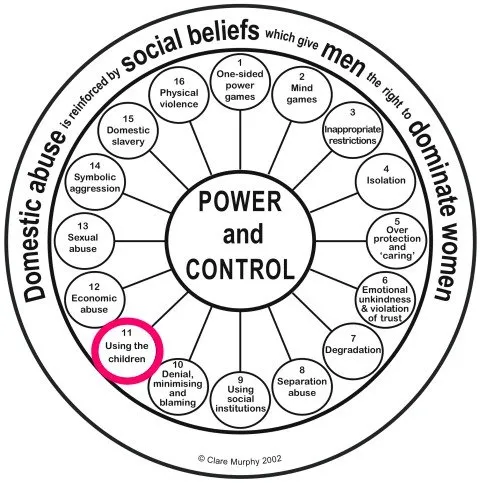 Ways men use the children to maintain power and control or to punish their partner or ex-partner include demanding that she do all the childcare, making her feel guilty about the children, telling her he wouldn’t lose his temper if she kept the children quieter. Some men undermine her relationship with the children, for example when she sets clear boundaries he will then tell the children they’re allowed to do the thing their mother had said ‘no’ to. Some men also undermine her parenting by telling her she’s a bad parent and by purposefully belittling her in front of the children.
Some men use the children by threatening to take them away or kidnap them if his partner leaves him, or they threaten to have the children taken into care of child protection services or they threaten to harm the children, or actually do harm the children.
Women with children are more likely to be abused by their partner than are women without children.1 When men do abuse their partner this increases the likelihood he will abuse the children — physically, sexually, psychologically. And the more frequent the abuse towards their partner, the higher the chance the children will be abused too.2
Many men who coercively control their partner use children as weapons to get at her, control her, and keep her in her place.
Quite soon after starting her relationship with Luke, Heather did not want to be with him because he was abusing her. She wanted to leave and do her teaching degree, however she got pregnant, but did not want to share a child with Luke, so she told him she was going to have an abortion. However, fitting with his possessive attitude, he did not want her to have an abortion so he served High Court papers on her to prevent her from having an abortion. However, as Heathersaid, “He actually dropped the court case. I just got to read the papers recently through the hospital because he tried to sue the hospital as well. I thought he was so powerful and I just couldn’t mess with him. Even when I had our son he said in one of the affidavits that ‘she’s going back to work, that she obviously doesn’t want our son, so I’ll have him those times’. So if I went back to any work of any sort of description where he thought I was neglecting our son he would be on me. I never went out because he’d say, ‘you’re not going out leaving our son with your parents’. Yet he would never offer to look after him while I went out.”
Despite Luke seeming to want to have a child, this was not his actual motivation for trying to prevent the abortion. Many men with possessive attitudes use the children to maintain power and control over their partner. Heather discussesLuke’s attitude after they separated: “He made comments like ‘I wish you loved me like you love our son’. If I went to town he would grab the pram and say, ‘I know that when I’ve got our son you won’t go far away.’ He’d say, ‘If I had our son you’d come and live with me because you wouldn’t be away from him.’ I went and said to the counsellor, ‘I don’t want to be with Luke’. I said I want it so we have smooth running, we’ve got this child now, I want to get on with my life and Luke to get on with his and sort out some sort of arrangement until our son’s older, whether he comes and visits him at my place, or we meet on a Sunday afternoon until he’s old enough to be taken on his own. I want to remain friends so it’s easier for our son. But then Luke had me on his own and said ‘there’s no way we can be friends. I’m not going to be friends with you if you’re not going to live with me’.”
Pauline describes how Chris used the children to manipulate and maintain control over her, claiming that he could not spend time with his children because he’d rather spend time elsewhere. Pauline said Chris wouldn’t agree to an access order for the children, so when they were in the Court, “he said, ‘No court or judge is telling me what to do.’ So we had it on agreement and he walked out of court and he turned around and said, ‘Stick your fucking agreement.’ He said, ‘I can’t have the kids, I want to go to Rotary gatherings.’ Contact with the children has been very much to his timetable.”
Many men use the children in an attempt to punish their partner. And the children are negatively impacted as a result.
Raewyn also discussed how her husband Brian would use the children as a tool to prevent her from getting her needs met. Raewyn said, “Once I’d left he would play games about having the children because he knew I wanted a break and he would almost bribe me and say ‘Raewyn let’s talk about marriage and why this has happened and then I’ll see if I want to have the children’. He’s still doing it now. He’s using the children to get at me and they suffer. I suffer because I don’t get my break, but they suffer the most because if he’s not happy with me he doesn’t have them. It’s not so bad but he doesn’t have them very regularly. He could go a whole school-term and not see them. I know he does this because he told a mutual friend of ours because she asked him ‘why don’t you have the children regularly every second weekend?’ He said, ‘No way I don’t want to make it easy for her, so she can have a nice weekend with her lover.’
Susan said, “I had applied for a protection order, but my lawyer was so slow and didn’t think there was anything to worry about. But Anthony had left a suicide note and he left it to the kids. I read it before the kids saw it. I was a nervous wreck. Imagine if the kids had seen this and what it would have done to them. Anthonydoesn’t give up. I ended up going to a women’s refuge because I didn’t feel safe at all. I spent five days at women’s refuge. I had to take a week off work. The kids were so confused about things. They weren’t happy being there. I said to him I can’t go on, I’ve found myself a house to rent.” But Susan lived in a rural area and had no transport, so the new house was close which meant Anthony could see it.Susan said, “it was the only empty house there and I had that thing that I had to have the kids close to him because he’d say, ‘My kids have to be with me or else I’ll fight you for custody’.
Men who use coercive control against their partner, know the woman’s vulnerabilities. The love and protection that many women have for their children is one area that those men use after separation to continue coercive control.
After Raewyn left Brian, “He actually went away, overseas, for quite a while, ten months, so it was all pretty quiet. I didn’t realise how blissful that was.” However, when he returned, Brian would use conversations about the children as opportunities to abuse Raewyn. Raewyn said, “if I rang him up to see if he wanted to have the children, he’d always have a go at me, every time. A lot of the time I was crying at the end of the phone conversations, or I’d get so mad at him. I don’t know how he does it, he just makes you feel bad. I just can’t stand him, and then it would happen the next time and the next time, because he would never say, ‘yes I want to have the children and I want to be a father’. No, no, it would be ‘Oh, you’re just using me for a babysitter.’ So the abuse was just as bad as when we were married. It was revolting. The children are still something he can get at me about, although I’m trying to not get sucked into that one.”
Some men who engage in abusive, controlling, or violent behaviours towards their partner also directly maltreat their children.
Raewyn said that although her husband never really had that much respect for her, the abuse and coercive control got worse once they had children. Raewynsaid, “When the eldest boy Paul was two years old, suddenly I felt something different, I thought what’s happened? He’d stopped bugging me and he was abusing Paul. I got scared. I thought at that time, ‘I’ve got to go, I’ve got to go.’ He was really horrible. That’s probably the most scaredest and the most I ever wanted to leave was at that point. When my son Paul was about five or six, I said to my sister, she was visiting, I said, ‘I’ve got to leave him for Paul’s sake’. She even agreed with me there, for Paul’s sake you’ve got to leave him Raewyn. And again it was like I was locked into it I couldn’t go, I just didn’t know if I had it in me to go.”
Other men who abuse their wives, may also control the children.
Raewyn gives an example of how her husband favoured one child over the other. For some children, this can create rivalries between them. Raewyn said that after she and Brian separated, “he went back to picking on me and he was also picking on Paul. And his abuse went a little bit further, because he would dote on the youngest boy, which would make it even worse for Paul. I would just be cryinginside for Paul because it was so obvious. That was horrible. I think what he was doing with the children really pushed me most to get out. The way he was treating Paul, he would know that it affected me badly. I got to the point where I used to say ‘stop picking on him’, and he knew it affected me. I think it made him do it more.”
Women with children are at higher risk than childless women, of being abused after separating from a man with a history of controlling behaviours.
When Adriana and Steve separated he threatened to kill her and he used their daughter as a pawn to control Adriana. As a result of the threat to kill her, Adriana worried how that threat would affect her daughter. She believed her daughter may be at some level of danger when she was in his care.
Adriana said her ex-husband tries to get their daughter to make a choice between them. She said it must be very very hard for her daughter to cope with his slurring at her and the family. Adriana said, “I have no control over it. There’s no way I can do anything about it, except, again be the rock, be the person who does things the right way. Being the rock means supporting her in what she wants to do, being consistent with my parenting, to be consistent with her, living ongoing in a predictable way, loving her — for me all the normal parenting things. Not saying negative things about him in front of her.”
Adriana said her ex-husband, “was a great father when we were married, but after the divorce he fails to be a father or role model to our child. He fails to be consistent about seeing her. He doesn’t support her on any level I can detect because he doesn’t support all her interests, he jeopardises all her interests. He doesn’t support her financially in any way. He uses her for his own purposes which I think is the lowest of the lowest. For example he uses her as a negotiator between us, he buys her presents and does not let her bring them home or use them.”
Many coercively controlling men (especially if they have money) use children to battle for contact or day-to-day care in the family court.
Research shows that many of those men are able to put on a charming façade when outsiders observe their fathering. Adriana said, “The court system is quite steadfast on any access. The court believes any relationship with the father is better than no relationship — even if it hurts the child. Not necessarily physically because he hasn’t been physically violent. We had a couple of psychologist’s reports and the psychologist looked at the way he behaves towards her for an hour and made an assessment of that. The report showed nothing like the reality. It didn’t show things like the fact he calls her up and asks whether she’s slim or not. But again I had no control over that because he is her parent, he is a guardian so he has amazing power not only over her, but over me and it is given to him by the legal system and by the structure. There’s the hard bit because there’s no way as an individual that I can fight it. He’s got the right to make decisions for her, which obviously influences my life.”
Elizabeth said that, David “took out custody proceedings yet there was no way he could look after the kids” because as Elizabeth said, she had “looked after them all the time that we’d had them. They were little children.”
Using the children in this way to maintain control over Elizabeth was despairing for her. She said that David “had these people he called nannies, they were just girls that he had picked up wherever he picked them up that he called nannies. I remember one holiday I dropped the girls around there so that he could pay a teenager to look after them while I went out cleaning. The whole thing was just soback to front. I would say, ‘I’ll look after the kids. I’ll have the kids.’ ‘Oh no no.’ There was no way he was going to let that happen. We went to mediation, we went through the whole legal process, and to mediation for custody of the kids, and the kids had lawyers and the kids had psychological reports and that whole business — which was very hair raising. And he has this wonderfully charming persona, he is very proper and very charming and of course he’s got his professional life and his lovely home and here I am scraping to stay alive.”
Many men who abuse their partners, show a lack of responsibility as fathers.
These fathers lack interest and involvement and do not fulfill the huge range of parenting tasks required. Instead, the mother often has to take up the slack and do all the things for the children that the father neglects to do, such as organising school camp, all the equipment and logistical arrangements that go along with that, organising school uniforms, medical appointments, ensuring medication is administered on schedule, ensuring children have a balanced healthy diet, and so forth. Many men who control their partners just want the public kudos of being a father, but not all the hard work that committed healthy parenting requires.
Elizabeth said, “When I left, I stayed at my girlfriend’s. The children were living in the house where he was living. I used to come in at seven o’clock in the morning to seven at night to look after them, as we had four children at that stage and the youngest was three. He used to leave me lists of things to do, I had to do this and I had to do that. If I went to the supermarket to buy food he wanted to see the receipt to make sure that I hadn’t bought anything for myself. I couldn’t get onto a benefit because even though I was looking after the kids 12 hours a day, because they were sleeping at his house, I couldn’t claim a benefit, because technically they were in his care. Not that I was really into looking at benefits at that stage, because I never saw myself as someone who should be going on a benefit. I couldn’t claim child support because again they were in his custody, that is where they spent the night is the thing that counts.”
Children are impacted in a variety of ways when their father uses them as a tool to control their mother.
How children are impacted depends on their age, the kind of control and manipulation they experience, the strength of bond they have with their father, mother and siblings and the degree to which their father undermines those bonds. Children’s needs for psychological and physical safety may be diminished, their ability to focus and enjoy school may be impeded and some children may develop physical illnesses. Children may try to stop the abuse, while others may feel powerless to change anything. Some children become confused, anxious or depressed. Yet other children may be very resilient — especially if they have good stable supports and they are able to talk to trusted family, friends or people in the wider community about what they are experiencing.
Watch out for blogs on the following control tactics:
One-Sided power games
Mind games
Inappropriate restrictions
Isolation
Over-protection & ‘caring’
Emotional unkindness & violation of trust
Degradation & Suppression of Potential
Separation Abuse
Using social institutions & social prejudices
Denial, Minimising, Blaming
Economic abuse
Sexual abuse
Symbolic aggression
Domestic slavery
Physical violence
Mind games
Inappropriate restrictions
Isolation
Over-protection & ‘caring’
Emotional unkindness & violation of trust
Degradation & Suppression of Potential
Separation Abuse
Using social institutions & social prejudices
Denial, Minimising, Blaming
Economic abuse
Sexual abuse
Symbolic aggression
Domestic slavery
Physical violence
References:
- Humphreys C. Domestic violence and child protection: Challenging directions for practice. Australian Domestic and Family Violence Clearinghouse: Issues Paper 13. 2007.
http://www.austdvclearinghouse.unsw.edu.au/documents/IssuesPaper_13.pdf. - Baker LL, Cunningham AJ. Helping children thrive: Supporting woman abuse survivors as mothers. London, ON, Canada: Centre for Children & Families in the Justice System, London Family Court Clinic, Inc., 2004.
http://www.lfcc.on.ca/HCT_SWASM.pdf.
{ 1 comment… read it below or add one }
Wednesday, April 24, 2013
An open letter to lawyers who have clients involved with sociopaths
An open letter to lawyers who have clients involved with sociopaths
Dear Mr. or Ms. Esquire,
When a client tells you his or her opponent is a sociopath, please be aware of the ramifications for your legal case.
First of all, do not disregard the statement just because the opponent hasn’t killed anyone. A common perception is that sociopaths are all deranged serial killers. This is not true—only a small percentage of sociopaths commit murder. But all sociopaths are social predators, and live by exploiting others.
Frequently this is financial exploitation—many sociopaths are skilled con artists—but not always. Sociopaths also target people who can provide them with a place to live, business connections, sex, housekeeping or other support services, children, or a respectable image in the community while they live double lives. The point is that sociopaths intentionally use manipulation and deceit to hook their target. They continue the manipulation and deceit to keep the exploitation going, bleeding the target until there is nothing left. At that point, some sociopaths abandon the target, moving on without a backward glance.
Sometimes, however, the target gets wise to the sociopath, and wants to end the involvement. At this point, some sociopaths become enraged at the possibility of losing control, and set out to crush the target. They are not interested in compromise or equitable distribution. They do not want to give the target whatever he or she is entitled to. They want to grind the target into the dirt.
What you need to understand about sociopaths
1. A sociopath’s prime objective is power and control. All they want is to win.
2. Sociopaths love the drama of court because it gives them an opportunity to win. They do not consider the possibility that they may lose. If they do lose, they view it a bump in the road, and figure out how to attack the target again. Forcing the target to incur steadily mounting legal expenses is considered a win.
3. Sociopaths lie. They lie convincingly. They have no qualms about lying in court documents or on the witness stand.
4. Sociopaths manipulate other people to lie for them. These witnesses may not know they are lying—they may simply believe everything that the sociopath has told them, because sociopaths are so convincing.
5. Sociopaths feel no obligation to follow court orders or the law. They only follow court orders or the law if they perceive an advantage in doing so. But they are experts at figuring out ways to use the law to further their objective, which is to crush your client.
How people become targets
Most of us believe that people are basically good inside and everybody just wants to be loved. Because we do not know that there are exceptions to these beliefs—namely, sociopaths—we have huge blind spots that these predators can exploit.
No normal person intentionally becomes involved with a lying, manipulative sociopath. So when your client tells you outrageous stories of the sociopath’s behavior, and also says he or she never knew about the behavior, or accepted the sociopath’s explanations, your client is most likely telling the truth.
How do these entanglements happen? Sociopaths are always on the lookout for people they can use. When they encounter someone through any social interaction, they quickly evaluate whether that person has something that they want. If the answer is yes, they assess the person for vulnerabilities. Then they figure out how to exploit the person’s vulnerabilities to achieve their objective.
Sociopaths engage in calculated seduction. If you’re handling a divorce case, the seduction was romantic. If it’s some other type of case, the seduction may have involved shared beliefs, aspirations or goals. Either way, in the beginning of the involvement the target is subject to a wonderful honeymoon of admiration and promise.
Once the target is hooked, the sociopath begins the exploitation, while simultaneously ramping up manipulation to keep the target under control. This may involve:
- Isolating the target from his or her support network
- Emotional, psychological, verbal, physical, sexual or financial abuse
- Gaslighting—making the target doubt his or her own perceptions
What you need to understand about the target
1. Involvement with a sociopath is like living in a black hole of chaos. Your client, the target, has probably had every aspect of his or her life disrupted:
- Career interrupted
- Finances ruined
- Health compromised
- Home and property neglected
- Relationships shattered
By the time the legal action commenced, your client may have already been in free fall for a long time. He or she may feel overwhelmed by the magnitude of the issues that need to be addressed.
2. Involvement with a sociopath can cause post-traumatic stress disorder (PTSD). At one time PTSD was diagnosed only in relation to a single traumatic event that involved risk of serious injury or death, coupled with intense fear, horror or helplessness. A new definition identifies a type of PTSD that results from cumulative trauma and long-term injury.
3. PTSD is a psychiatric injury (not a mental illness). PTSD causes biochemical changes in the brain and affects certain areas of the brain’s anatomy. Common symptoms include intrusive thoughts, nightmares, flashbacks, difficulty concentrating and exhaustion.
4. The litigation against the sociopath makes your client re-experience the underlying trauma and triggers the symptoms of PTSD. Dr. Karin Huffer, in her book Unlocking Justice, explains what happens:
Mentally reliving the trauma during legal proceedings simultaneously activates parts of the brain that support intense emotions while diminishing the functions of the central nervous system that controls motor output, regulates physiological arousal, and impedes the ability to communicate in words. Memory fails and intrusive emotions sabotage concentration on the task at hand. Litigants feel incapable of the spontaneous verbal response and interaction required in typical courtroom exchanges. As a result, the litigant with PTSD might be driven to avoid topics. They literally do not hear them. They disconnect when they need to engage. And, at times, they clearly are nonfunctional and are unable to communicate their symptoms and needs in a formal manner accepted by the courts.
5. Targets of sociopaths have been deceived, betrayed and perhaps subject to violence. They approach the courts expecting justice, which sociopaths actively thwart. When justice is denied, and targets instead experience profound and prolonged injustice, their PTSD takes on another dimension, which Huffer identifies as “Legal Abuse Syndrome.”
Your client’s experience
The goal of this letter, Mr. or Ms. Esquire, is to help you understand what your client has experienced. My objective is to explain why he or she may be having difficulties with the litigation process, and difficulties moving on in life. The sociopath intentionally used your client—perhaps for years—and may be intentionally attempting to destroy him or her now.
Your client is not irrational, lazy or obstinate. Your client is having a normal reaction to profound betrayal.
Sincerely,
Donna Andersen
Author, Lovefraud.com, and a former litigant against a sociopath
Author, Lovefraud.com, and a former litigant against a sociopath
Subscribe to:
Posts (Atom)